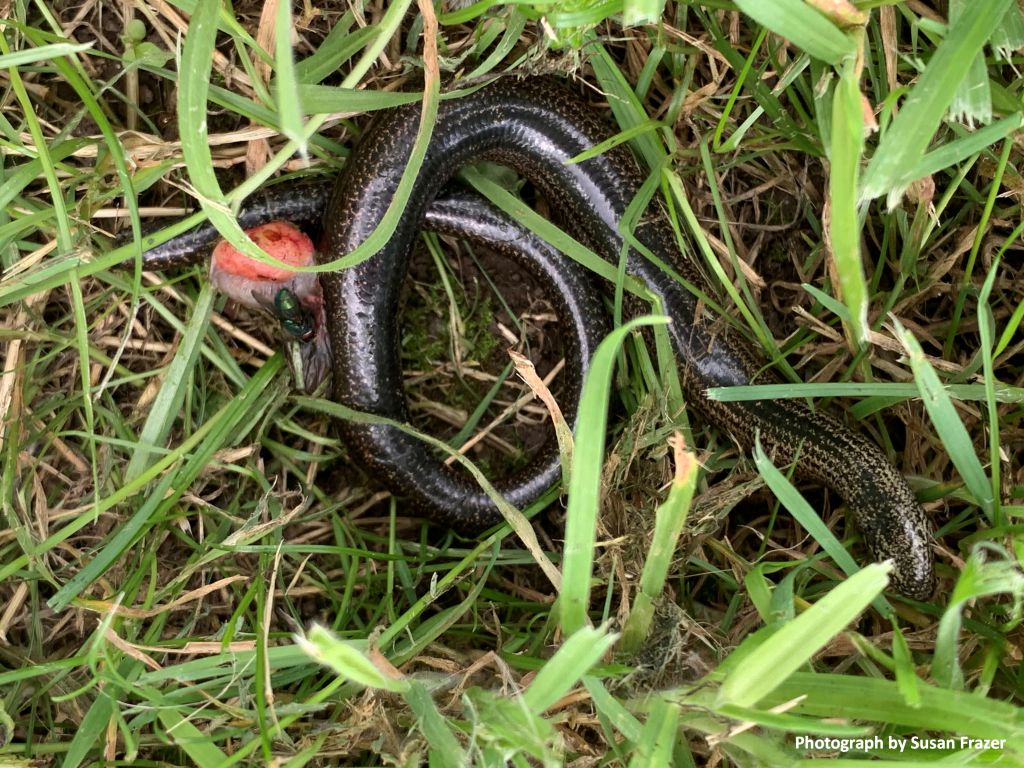
Early last year we were given a few rolls of turf for repairing the edge of the new pond where heavy footfall at the “beach” end had made a muddy patch. We were a bit tardy in using the turf, and by the time we got around to moving it, we discovered that it had been colonised by ants and more surprisingly – slow worms.
Slow worms are not in fact worms at all. Neither are they snakes to which they bear a strong superficial resemblance. They are legless lizards – reptiles. We already knew that there were some slow worms in the Charlton Down Nature Area. Their dead bodies had been found several times after a motor mower had been used to cut the paths. They had also been spotted alive by visitors on a few occasions, right on the path near the entrance gate.
We decided that we should encourage the presence of slow worms by giving them special safe places to hide. We did some on-line research and discovered that a well-known way of making reptile refuges is to lay down sheets of corrugated iron (CI). The tunnels created by the undulations of the sheet make it easy for creatures to get in and out; while the metal warms up in the sun and keeps the temperature favourable.
Sourcing some suitable corrugated iron proved a bit of a problem. Entire sheets would be too big for such a small site as ours and we couldn’t afford to buy them in anyway. Transport costs are huge. We had no means of cutting up entire sheets to a more useable size. In the end, we heard that a nearby derelict barn was being renovated and a new roof installed. We were allowed to help ourselves to the discarded broken pieces of old roof. To be honest, this was not ideal because it was not the traditional type of CI. It was lightweight and light-coloured, and the pieces were irregularly-shaped off-cuts with rectilinear channels instead of the usual curvilinear ones. But it would do for the job.
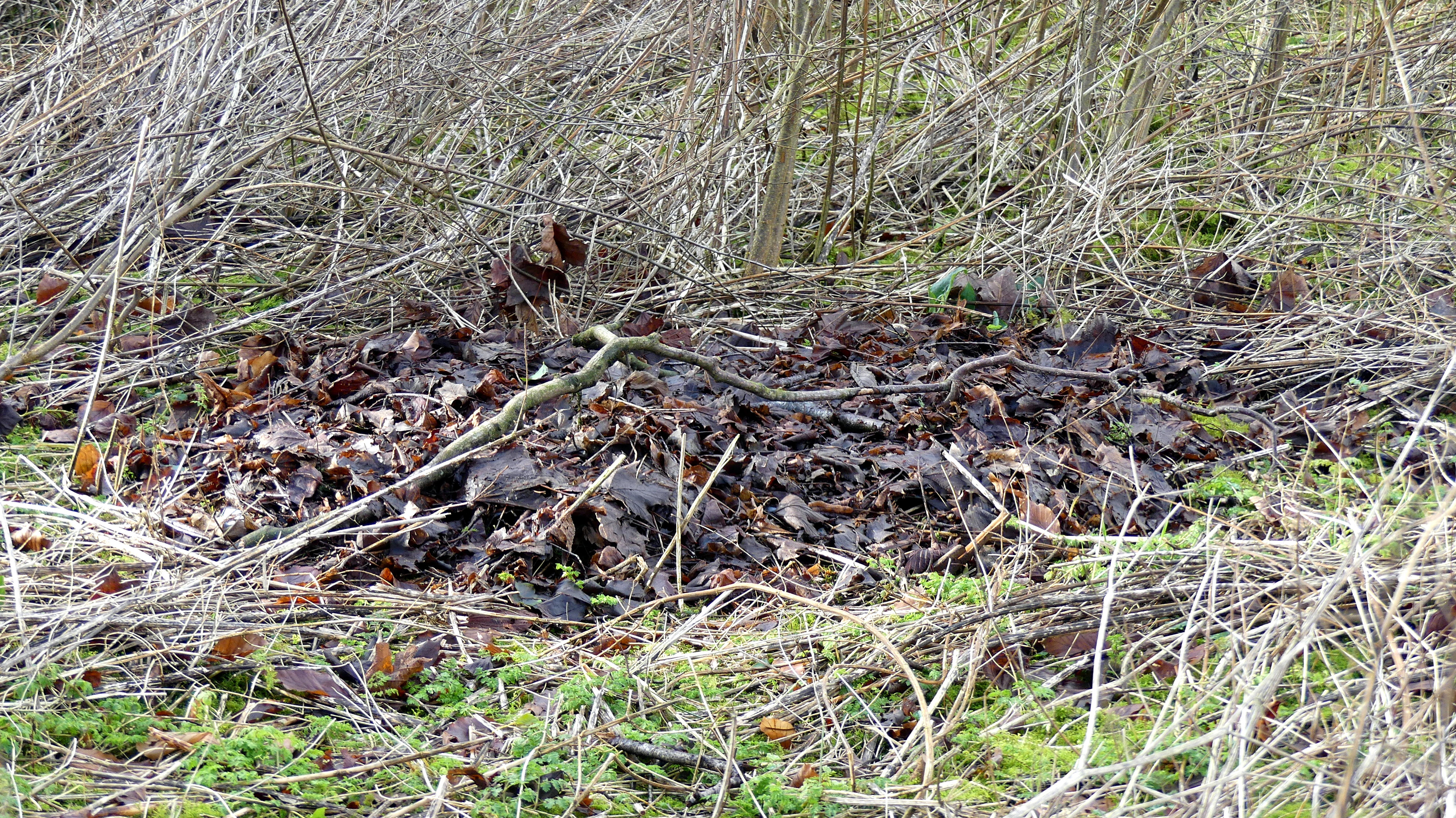
We had three pieces and we needed to place them where they were not too obvious to passing visitors. Unfortunately, anything is potentially liable to interference from a small minority of visitors. Ideally the reptile refuges should be placed where they would be in a sunny spot but this would mean putting them out clearly visible in the open. In the end, we compromised by putting one out where it would easily warm up but would be hidden by tall vegetation in summer, and the other two were placed under the over-hanging branches of trees.
A bed of wood chippings formed the base for each piece of CI. We used dried leaves on the top to conceal them. High winds and stormy weather blew these away during the winter, so we went back and scattered more chippings and leaves on top with a few slender branches and twigs to keep them in place. This strategy has worked and even the recent storms Eowyn and Herminia have had no impact on them.
We are hoping that these shelters will be used by the slow worms, and also frogs and other creatures. We will not disturb the refuges for quite a while and need to be very careful when we do. There are rules and precautions needed when checks are made to protect the creatures and the observers. We have never seen any snakes in the Nature Area or the locality but they might actually be around and not noticed. Extra caution is needed if there is a possibility that snakes have taken up residency.


Useful Links
Slow Worms – The Complete Guide
The Wildlife Trusts – Slow Worm
Discover more from Charlton Down Nature Area
Subscribe to get the latest posts sent to your email.


Great idea—simple but effective.
Oh, just by the way, our snowdrops are flowering.
LikeLiked by 1 person
Thank you, Markus.
LikeLiked by 1 person